About Trials and HUX
|
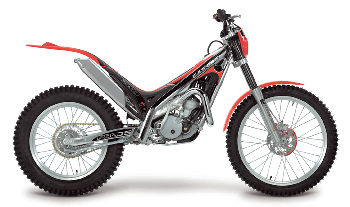
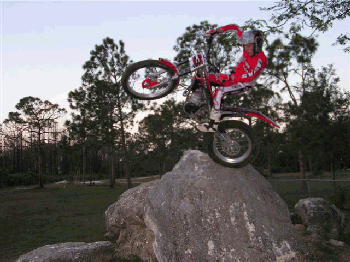
About TrialsGeneral description of observed motorcycle trials....Motorcycle trials are non-speed events on specialized motorcycles. Riding over and around natural obstacles without contacting the ground. Points are awarded for contacting the ground or failing to complete the "section". The rider with the least points after completing all sections, is the winner. The sport is very popular in the UK. though there are participants all around the world. The bikes....Trials motorcycles are very distinctive, in that they are built mainly for off-road use, are extremely light weight, have no seat (they're designed to be ridden standing-up) and have short suspension travel, compared to a motocross or enduro motorcycle.
The trial itself....The event is split into "sections" (commonly ten) where a competitor rides through a natural obstacle course, while attempting to avoid touching the ground with his or her feet. In many local trials events, the sections are divided into separate routes to accommodate the different skill level of riders, who compete in skill-rated classes. In every section, the competitor is scored by an observer, who counts how many times the competitor touches the ground with their foot (or any other part of their body). Each time a competitor touches the ground with a foot (commonly called "dabs"), they are penalized one point. Scoring....The possible scores in each section consist of 0, 1, 2, 3, or 5. If a competitor makes his way through the section without touching the ground with his/her foot, they are given a score of 0 (called "cleaning the section"). If they touch the ground only once, they are given the score of 1. If they touch down twice, they are given the score of 2. If they touch the ground three times or more, they are given the score of 3, as long as they complete the section without stalling the motor, dismounting, going out of bounds or going backwards. If the competitor fails to complete their way through the section, or takes the wrong route, or goes backwards, they are given a score of 5.
Normally, the winner is the competitor with the least points at the end of the event. Some events are also timed with penalty points awarded to late riders. Different classes....There are also special "Classic" classes for vintage bikes - typically British (pre-1965), as well as a "Twinshock" class for trials-motorcycles with two rear shock absorbers. In most cases, twinshock motorcycles were manufactured before 1985 and are typically Japanese or Spanish.
About HUX
Privacy PolicyThe Club takes data security very seriously and you can read the HUX Privacy Statement by clicking HERE The Club's ConstitutionYou can get a copy of the Club's Constitution by emailing us, at the address on our contact page.
|